

What Are the Top Patio Table Manufacturers in China?
Choosing a patio table manufacturer in China involves more than comparing catalog photos or quoted prices. Buyers need to understand what each supplier actually makes, how production is controlled, and whether its products suit the intended market. A neat showroom helps, but it cannot replace evidence.
This guide explores leading Chinese manufacturers and the practical differences that may matter to importers, retailers, and hospitality projects. It considers product range, material options, customization, production capacity, communication, and export support. Details such as aluminum wall thickness, weld consistency, coating quality, and the fit of a tabletop can affect durability and customer satisfaction. Packaging matters, too: a carefully finished table can still arrive with scratched corners if cartons and protective inserts are poorly designed.
Look for verifiable information, not confident claims alone. Factory audits, product samples, test reports, and clear warranty terms can help buyers assess a supplier, though each should be checked against project requirements. Ask whether the company is a direct manufacturer or a trading business, and confirm lead times, minimum order quantities, and customization limits in writing. Small details count.
There is no universal “best” choice. A supplier suited to a large resort order may not fit a small retailer seeking flexible designs. The comparisons ahead offer a starting point, not a substitute for due diligence. Some information may change, and that deserves attention. Before placing an order, request current specifications and inspect a sample whenever possible.
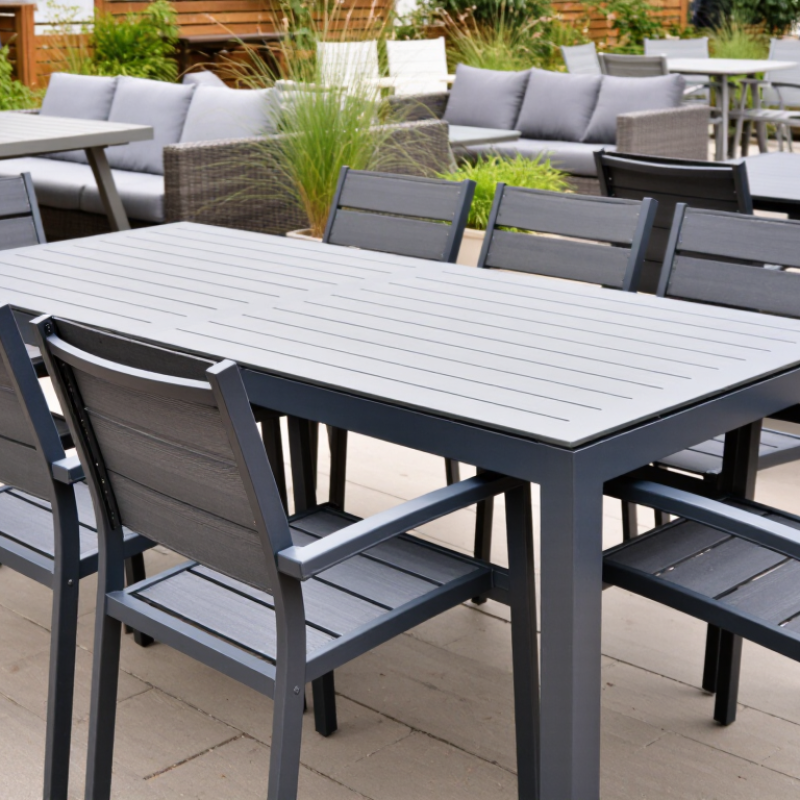
How China’s Patio Table Manufacturing Industry Is Organized
China’s patio table industry is organized as a connected supply chain, not one uniform production system. In coastal manufacturing regions, metalworking, wood processing, surface finishing, and packaging businesses often operate within practical reach. A table maker may design frames in-house, while nearby suppliers cut aluminum tube, cast fittings, weave synthetic rope, or temper glass. This division helps factories adjust capacity by season. It can also make responsibility less obvious. Small detail, big consequence.
Many suppliers work as OEM or contract manufacturers. Buyers may provide specifications, or factories may adapt existing designs. Larger operations can manage engineering, welding, coating, assembly, and inspection under one roof. Smaller workshops often focus on one step, such as powder coating or wicker weaving. Trading and export-service firms may coordinate samples, paperwork, and shipping, but they are not necessarily the producer. Ask who controls drawings, materials, and final checks. Paper trails matter.
Quality depends on coordination. Purchasers commonly review frame dimensions, weld consistency, coating coverage, drainage, glass edges, and packaging strength. Salt-spray or load testing may be relevant, depending on materials and destination. Request reports that show test conditions, not just broad claims. Production audits and pre-shipment samples can reveal mismatched finishes or wobbly legs. Still, a sample is not the whole shipment. That deserves scrutiny.
| Industry Segment | Typical Role | Common Materials and Products | Typical Manufacturing Processes | What Buyers Commonly Evaluate |
|---|---|---|---|---|
| Material and component suppliers | Supply raw materials and parts to furniture factories, including metal stock, timber, tabletops, fasteners, and protective components. | Aluminum and steel tubing; timber such as teak or acacia; glass, ceramic, and compact surfaces; plastic parts and hardware. | Material cutting, forming, surface preparation, glass or ceramic processing, and component finishing. | Material specifications, consistency between batches, traceability, finish quality, packaging, and component availability. |
| Metal-frame specialists | Make frames and bases for outdoor tables, either as finished products or as components for other furniture manufacturers. | Aluminum and steel dining-table frames, folding bases, pedestal bases, and support structures. | Tube cutting, bending, welding, drilling, assembly, and finishing. Powder coating is commonly used on prepared metal surfaces. | Frame stability, weld quality, corrosion protection, coating consistency, load performance, and dimensional accuracy. |
| Woodworking manufacturers | Produce wooden table components or complete tables, often combining machining, joinery, sanding, and finishing operations. | Outdoor dining tables, folding tables, slatted tops, and solid-wood or mixed-material designs. | Timber conditioning, cutting, machining, joinery, sanding, assembly, and application of suitable outdoor finishes. | Wood species and grade, moisture management, construction details, finish suitability, responsible sourcing documentation, and maintenance guidance. |
| Tabletop and surface specialists | Supply finished tops or surface components to table assemblers and integrated furniture factories. | Tempered glass, ceramic, stone-look surfaces, compact panels, and other outdoor-suitable tabletop materials. | Cutting, edge finishing, surface treatment, drilling where required, inspection, and protective packing. | Thickness and dimensions, edge quality, surface durability, safe handling, packaging protection, and compatibility with the base. |
| Integrated patio-table manufacturers | Coordinate design, component sourcing, production, assembly, inspection, and packing for complete tables. | Metal, wood, and mixed-material tables in dining, café, bistro, folding, and occasional-table formats. | May combine in-house fabrication with purchased components; final operations typically include assembly, inspection, and export packing. | Production capacity, sample approval, customization capability, quality-control procedures, lead-time planning, and communication throughout production. |
| OEM and ODM production | OEM production follows a buyer’s specifications; ODM production may include supplier-developed designs adapted for a buyer. | Private-label collections, customized dimensions, finishes, materials, and packaging. | Design review, prototype or sample development, specification confirmation, production runs, and pre-shipment checks. | Ownership and approval of drawings, change control, minimum order quantities, tooling responsibilities, sample-to-production consistency, and inspection criteria. |
| Export and quality coordination | Manufacturers or trading and sourcing partners coordinate documentation, shipment preparation, and destination-market requirements. | Finished tables and sets packed for retail, project, or wholesale distribution. | Carton design, labeling, packing checks, export documentation, and shipment coordination. | Packaging strength, labeling accuracy, agreed inspection plans, shipping terms, product documentation, and compliance checks for the destination market. |
| Product safety and standards checks | Testing and inspection help verify that a product meets the requirements agreed for its intended market and use. | Applicable to finished outdoor tables and their materials, finishes, joints, and structural components. | Checks may include stability, strength, durability, surface or finish review, and packaging inspection, depending on the product and market. | Confirm the current requirements with the buyer or an accredited testing provider. EN 581 includes requirements and test methods for outdoor furniture, including outdoor tables. |
Related Posts
-

Why Choose an Outdoor Furniture Set for Global Buyers?
-
How to Choose the Best Patio Furniture for Any Space?
-
Who Are the Best China Lawn Furniture Suppliers?
-
China Top Outdoor Patio Set Manufacturers for Global Buyers
-

Innovative Patio Table Designs and Insights from the 2025 China Import and Export Fair
-
What is the Best Outdoor Patio Table and Chairs for Your Space