

Sourcing outdoor seating for global buyers in 2026 requires more than comparing catalog prices. Buyers must examine comfort, weather resistance, packaging, certifications, lead times, and supplier consistency. A chair may look elegant in a showroom, yet fail after one rainy season or several long restaurant shifts. Small details matter, including drainage holes, corrosion-resistant fasteners, UV-stable fabrics, and replaceable cushions.
Richard Frinier, a respected outdoor-furniture designer, has expressed a central principle: “Outdoor living should feel as comfortable and considered as indoor living.” This idea remains valuable for international purchasing teams. Outdoor seating should support real behavior, not only attractive photography. A resort may need stackable chairs for storage. A café may require narrow frames for crowded terraces. A residential project may prioritize deep cushions and soft, flexible colors.
Global sourcing also demands practical judgment. Factory audits, sample testing, and production inspections can reveal problems early. However, no checklist removes every uncertainty. Material performance can change across climates, and supplier communication may weaken under deadline pressure. Some buyers may also overvalue low prices and underestimate replacement costs. That mistake is common.
This guide explores how to evaluate suppliers, materials, testing methods, logistics, and responsible production choices in 2026. It focuses on evidence rather than promises. Product samples should be touched, measured, and tested. Specifications should be written clearly. A reliable sourcing strategy is never perfect, but it should become more accurate with every order.
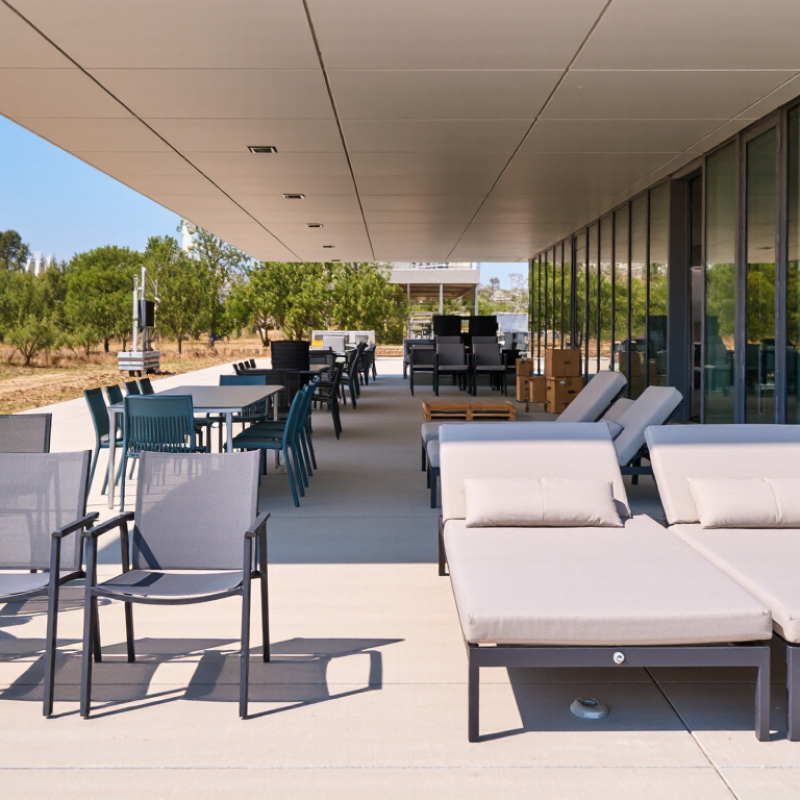
Global buyers should define outdoor seating needs before requesting supplier quotations. Begin with the setting, user profile, climate, and expected daily traffic. A rooftop café needs different furniture from a hotel pool deck or public garden.
Record practical dimensions, including seat height, table clearance, armrest width, and maximum user weight. Specify whether chairs must stack, fold, or remain fixed. Measure storage space carefully.
Small details matter.
For 2026 sourcing, the buyer brief should cover materials, UV exposure, rain, salt air, cleaning chemicals, and replacement parts. Ask for test reports, material declarations, installation instructions, and product traceability.
Requirements may differ by destination, so verify applicable safety and chemical rules with qualified local professionals.
Paperwork matters.
Request samples before approving a large order. Check color consistency, surface temperature, drainage, stability, and packaging damage. Compare minimum order quantities, lead times, spare components, carton sizes, and delivery terms.
Our first seating brief was too broad, and it caused avoidable revisions. That mistake is worth remembering.
Seating that looks durable in a showroom may perform differently beside strong sun, wet tiles, or coastal wind.
How to Source Outdoor Seating for Global Buyers in 2026
Outdoor seating decisions now depend on climate evidence, not showroom appearance. Aluminum resists rust, but salt air can still attack joints and fasteners. Teak handles moisture well when properly seasoned, though its color changes without maintenance. Recycled HDPE tolerates rain and ultraviolet exposure, but heat expansion needs careful design. The Circularity Gap Report 2024 estimates that only 7.2% of the global economy is circular. Buyers should therefore examine recycled content, repair options, and end-of-life separation.
Weather testing must match the destination. Ask suppliers for results based on ISO 4892-3 ultraviolet testing, ASTM G154 exposure, and corrosion testing where relevant. Powder-coated frames need evidence of coating adhesion and salt-spray performance. Cushions require fabric colorfastness data, water drainage, and mold resistance. A dry warehouse test is not enough. Coastal balconies are harsher.
Tips: Request samples before volume orders. Place them outdoors for 30 days, including rain and direct sun. Measure fading, standing water, loose joints, and surface temperature. Check whether covers, slings, screws, and replacement cushions remain available for five years. Product lifespan claims can be vague. I would not treat a long warranty as proof of durability; warranty exclusions may hide the real risks. Product repairability matters more than attractive packaging.
Global outdoor furniture demand is expanding. Fortune Business Insights valued the market at USD 19.45 billion in 2023 and projects continued growth through 2032. That growth attracts capable factories, but also inexperienced traders.
Start with the factory, not the catalog.
Request its legal manufacturing address, employee count, monthly capacity, and process photographs. Then compare these details with an independent audit. A reliable supplier should show separate areas for aluminum cutting, welding, powder coating, weaving, and final inspection. Ask for production records from recent outdoor seating orders. Empty workshops are a warning.
Request a pre-production sample.
Check frame alignment, weld penetration, drainage holes, fastener materials, and cushion stitching by hand. Test a chair for wobble and repeated loading. ANSI/BIFMA seating standards provide useful performance benchmarks, while ISO 4892-3 supports accelerated weathering evaluation. For coastal projects, request corrosion testing based on ASTM B117, but do not treat laboratory hours as real-life proof. They are only indicators.
Review material certificates, inspection reports, and corrective-action records. The 2024 World Quality Report highlights growing dependence on documented quality processes and traceability. Suppliers should identify batches for fabric, coating powder, and hardware. Require third-party inspection before shipment. I have seen attractive samples hide inconsistent welds in later production. Trust needs evidence, not confident emails. Recheck the evidence.
For global buyers in 2026, outdoor seating decisions should compare landed cost, compliance, customization, and minimum orders.
A low factory quote can hide freight, packaging, inspections, duties, and replacement costs. UNCTAD’s Review of Maritime Transport 2024 states that shipping carries over 80% of global merchandise trade. Delays can quickly change the real price. Ask suppliers for a landed-cost worksheet using your destination port, carton dimensions, and seasonal freight assumptions. Use evidence, not optimism.
Compliance needs a product file, not a sales promise. Request material specifications, load-test records, chemical declarations, and traceability for frames, coatings, cushions, and packaging. For European sales, check the General Product Safety Regulation and relevant EN 581 seating requirements with a qualified assessor. Other markets may require different fire, labeling, or structural tests. The European Commission’s 2024 Safety Gate reporting showed more than 4,000 product-safety alerts. That figure makes traceability difficult to ignore.
Tips: Compare three quotations on identical specifications. Set MOQ by SKU, color, and packaging version. Request one paid sample before bulk production. Custom finishes may raise tooling fees and extend lead times, so negotiate shared molds or modular dimensions. Do not assume one certificate covers every configuration. I still find this difficult: suppliers may pass tests on one fabric and ship another. Photograph samples, retain test reports, and write acceptance tolerances into the purchase contract.
Outdoor seating should be sampled like a finished product, not a showroom promise. Request one standard sample and one production-line sample. Compare frame dimensions, weld points, coating texture, fabric color, and cushion recovery. I once accepted a visually excellent sample that used thinner tubing in production. That mistake changed our inspection checklist.
Quality control needs measurable records. Check seat loading, joint movement, drainage holes, surface scratches, carton strength, and moisture protection. Photograph each inspection stage. A simple defect table helps suppliers correct repeated issues. Do not inspect only the first carton. Randomly open cartons from different pallet positions. Small details matter.
Shipping plans need more flexibility in 2026. Confirm carton measurements before booking space, because a minor change can affect container capacity. Review port congestion, fuel costs, currency movement, seasonal storms, and possible customs delays. Use moisture indicators inside long-distance shipments. Keep a practical buffer for delivery dates. Tight schedules create expensive decisions. Our earlier plans were too optimistic. I would now approve production only after signed specifications, packaging tests, and a realistic risk review.
INFORMATION CENTER
RESOURCES & MORE
INSPIRATION FOR YOU
© Copyright 1981 - 2025 | California Patio™ All Rights Reserved