

A Slat Bed Frame supports a mattress with a series of narrow, evenly spaced boards instead of a solid platform. The slats usually rest across the frame’s side rails, and some designs include a center beam with extra legs. Together, these parts distribute weight and help keep the mattress level. Simple in appearance, the frame still depends on careful spacing and secure connections. A loose slat can creak or shift under pressure. Small details matter.
Slats may be made from wood or metal, and their spacing varies by model. That spacing can affect how well a mattress is supported, so it is worth checking the mattress maker’s guidance before buying or assembling a frame. Foam, hybrid, and innerspring mattresses may have different support requirements. The open spaces between slats can also allow air to move beneath the mattress, though they do not prevent every moisture or comfort problem. There is no single design that suits every room or sleeper. It is easy to assume that any slatted frame will fit any mattress; that assumption deserves a second look. This guide explains how the frame’s parts work, what to check for compatibility, and which practical details can influence everyday use. A tape measure helps. So does a careful look at the instructions.
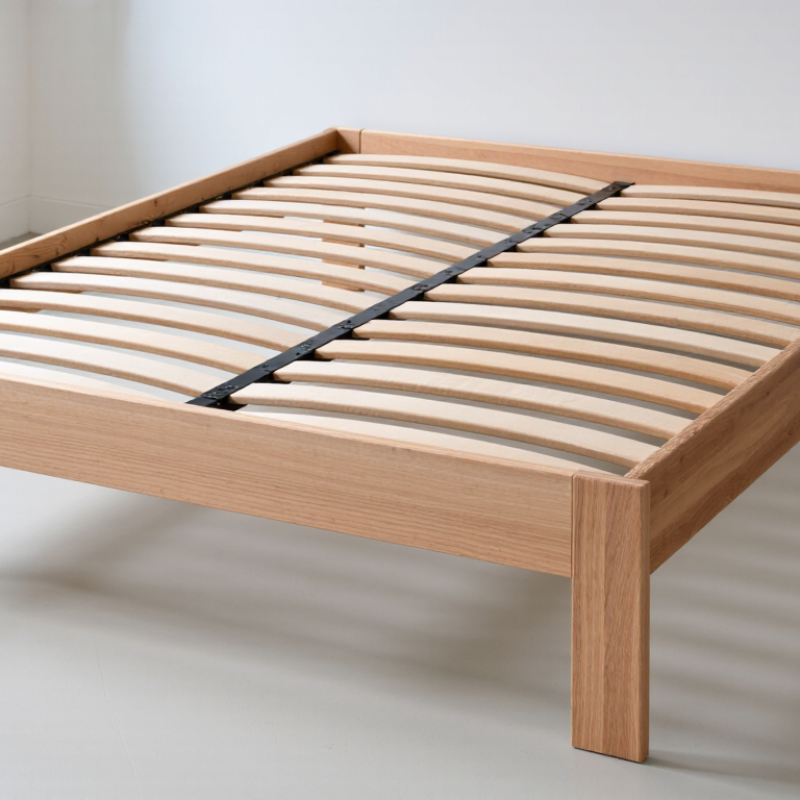
A slat bed frame uses side rails to hold a row of narrow boards beneath the mattress. The rails carry the boards; the slats spread the load across the frame. A center beam, often resting on floor-level legs, limits sagging across wider beds. Simple structure. Yet loose joints can creak, and a missing center leg may leave the beam unsupported.
The European standard EN 1725:2023 covers safety, strength, and durability testing for beds. ASTM F1566-14(2021) sets test methods for mattress sets, including durability tests, but does not establish one universal slat gap. That distinction matters: frame support and mattress performance are related, but not interchangeable. Check the mattress maker’s spacing guidance, then measure the clear gap between slats—not their center-to-center distance. Also inspect how the slats attach; a well-spaced row can still shift if its retainers are weak. These standards offer useful testing frameworks, not a guarantee that every frame suits every mattress. A small omission, like overlooking the center feet, can change how the whole frame bears weight.

A slat bed frame supports a mattress with a series of crosswise boards. When someone lies down, their weight presses into the mattress, then travels through the slats to the side rails and legs. The slats share that load rather than leaving the mattress to span one open space. That matters.
Load distribution depends on the slats staying level and properly supported. A central beam, often with supporting legs, helps carry weight in wider frames. Without enough support, slats may bow more near the middle, and pressure can collect around that area. The frame may creak, too. Small gaps help airflow, but gaps that are too wide can let some mattresses dip between boards. Check the mattress maker’s spacing guidance; it can vary by mattress type.
It is easy to assume every slat carries an equal share. In practice, pressure shifts when someone sits on the edge or changes position, so nearby slats may take more force. Flexible slats can give slightly, while rigid boards transfer pressure differently. Neither design fixes a crooked frame. If a slat is loose, cracked, or uneven, the load path changes. A quick look beneath the bed can reveal a shifted board or a missing center leg—small details, but easy to overlook.
How slats support a mattress: an illustrative model of load distribution across the frame.
In this simplified example, ten slats share a uniformly distributed load equally, so each carries 10% of the total. Actual load sharing varies with the mattress, slat spacing, frame construction, and where weight is applied.
A slat bed frame supports a mattress with parallel wooden or metal strips instead of a solid platform. The gaps matter as much as the slats. Many foam mattresses need spaces no wider than 2.75 to 3 inches, though exact limits vary by construction. Check the mattress care label or support guide before setting it down. Measure the open gap, not the slat itself. Small detail.
A tape measure gives a more reliable answer than eyeballing the frame. Measure several gaps, including near the center, where slats may shift or spread under weight. If an opening exceeds the stated limit, add compatible slats or a firm support board, if the mattress maker allows it. Keep airflow in mind; covering every opening may trap moisture in some rooms. Also check that the frame has center support and that its slats are secured, not bowed. A mattress can look level at first, then develop dips where foam bridges wide gaps. A quick inspection can miss a loose slat, so recheck after moving the frame or changing its load.
A slat bed frame supports a mattress on narrow strips fixed across the frame. The gaps between them allow airflow, while the strips carry the mattress and sleeper’s weight. Their material and flexibility affect how the bed feels. Solid slats are usually flat pieces of timber or engineered wood. They bend very little under pressure, creating a firmer, more even base. Press one gently in the middle, and it should feel fairly rigid. Solid support can suit people who prefer less movement, but the exact feel also depends on slat spacing and mattress construction.
Sprung slats are typically curved, layered wood strips that flex slightly when weight is applied. Their gentle give can soften pressure and add a little responsiveness beneath the mattress. A small difference. The movement may feel noticeable when sitting near the bed’s edge, though it varies with the slat design and frame. Flexible slats are not automatically more comfortable: too much movement, or widely spaced slats, may leave a mattress poorly supported. Check the mattress maker’s guidance on spacing and support before choosing. It is easy to focus on flexibility and overlook the frame’s condition; loose or damaged slats can change support over time.
| Feature | Solid Slats | Sprung Slats |
|---|---|---|
| What they are | Mostly flat, relatively rigid strips fitted across the bed frame to support the mattress. | Flexible, slightly curved strips fitted across the frame, commonly held in flexible end caps. |
| Common materials | Often solid wood or engineered wood; construction and strength vary by design. | Often layered, laminated wood designed to bend under load; the material and construction vary by model. |
| How they support a mattress | Provide a comparatively firm, steady platform, with support determined by slat spacing, width, thickness, and frame construction. | Support the mattress while flexing under pressure. Their effect depends on slat curvature, spacing, mounting, and the mattress above them. |
| Flexibility and feel | Generally flex less, creating a firmer and more uniform-feeling base. | Usually flex more, which can add a degree of give. The resulting feel also depends on the mattress and the sleeper. |
| Airflow | Gaps between slats allow air to circulate beneath the mattress. Airflow depends on the size and number of gaps. | Gaps between slats also allow airflow; the curved slats do not, by themselves, determine how much ventilation the bed provides. |
| Potential advantages | Simple construction and a stable support surface; individual slats may be replaceable if the frame design allows. | Can provide a more yielding support surface and may allow some adjustment in designs with movable sliders. |
| Things to check | Check the frame’s weight capacity, slat condition, center support, and maximum permitted gap between slats. | Check that slats are not cracked, detached, or overly bowed, and that end caps and any adjustment sliders are secure. |
| Mattress compatibility | Can suit many mattress types when the slat spacing and support meet the mattress maker’s requirements. | Can suit many mattress types when the mattress maker permits a flexible slatted base and the slats provide adequate support. |
| Best way to choose | Consider this option if you prefer a firmer, less yielding base and its spacing meets your mattress requirements. | Consider this option if you want a base with some flex; confirm that its movement is compatible with your mattress. |
How a slat bed frame works: Slats span the frame and distribute the mattress and sleeper’s load toward the side rails and any center support. Slat spacing, frame construction, and mattress requirements vary, so check the bed-frame and mattress instructions before use.
A slat bed frame supports a mattress through spaced wooden or metal strips, so compatibility depends on the gaps and the frame’s center support. Check the mattress maker’s current manual or warranty before buying. Look for the approved foundation type, maximum slat gap, required center legs, and weight limit.
Many manuals use a gap limit around 2–3 inches, but that is only a rough screening range, not a universal rule. Measure the open space between slats, not the slats themselves. Small detail, big difference.
ASTM International’s F1566-22 standard includes repeated-load methods for evaluating mattress-set durability. Its testing context is useful, but it does not certify that every slat frame will suit every mattress. Match the frame to the mattress maker’s written specifications, and keep a copy of those instructions. Check that the center rail rests firmly on the floor, where required, and that slats are secure rather than bowed or loose. I would also photograph the frame before setup; it makes later questions easier to answer. Don’t assume “fits the size” means “meets support requirements.”
INFORMATION CENTER
RESOURCES & MORE
INSPIRATION FOR YOU
© Copyright 1981 - 2025 | California Patio™ All Rights Reserved

