

How to Choose the Best Ceramic Tempered Glass?
Choosing Ceramic Tempered Glass starts with a simple question: what protection do you actually need? A glossy label cannot tell you how well a protector handles scratches, impacts, or repeated cleaning. Check the material description, thickness, edge finish, touch response, and warranty. Then compare those details with your phone model and daily use.
The market context is useful, but it needs careful interpretation. IDC’s Worldwide Quarterly Mobile Phone Tracker reported 1.24 billion smartphone shipments in 2024, up 6.4% from 2023. That figure signals a large market for screen protection; it does not prove that ceramic products outperform conventional glass. For technical context, ASTM C1048 describes heat-treated flat glass, while the term “Ceramic Tempered Glass” may be used differently by individual sellers. Ask for product-specific test methods and results. Look closely.
Materials scientist Donald Stookey’s pioneering glass-ceramic research is a useful reminder that composition and processing matter. This is a takeaway from his work, not a verified direct quotation. A trustworthy comparison should distinguish laboratory results from marketing language and identify the tested product, conditions, and failure criteria. Small details matter: a poorly fitted edge can lift, and a surface that feels smooth in-store may show wear later. No single specification guarantees a better experience. The right choice depends on your device, installation quality, and tolerance for glare or added thickness. This guide examines those trade-offs and shows what to verify before buying.
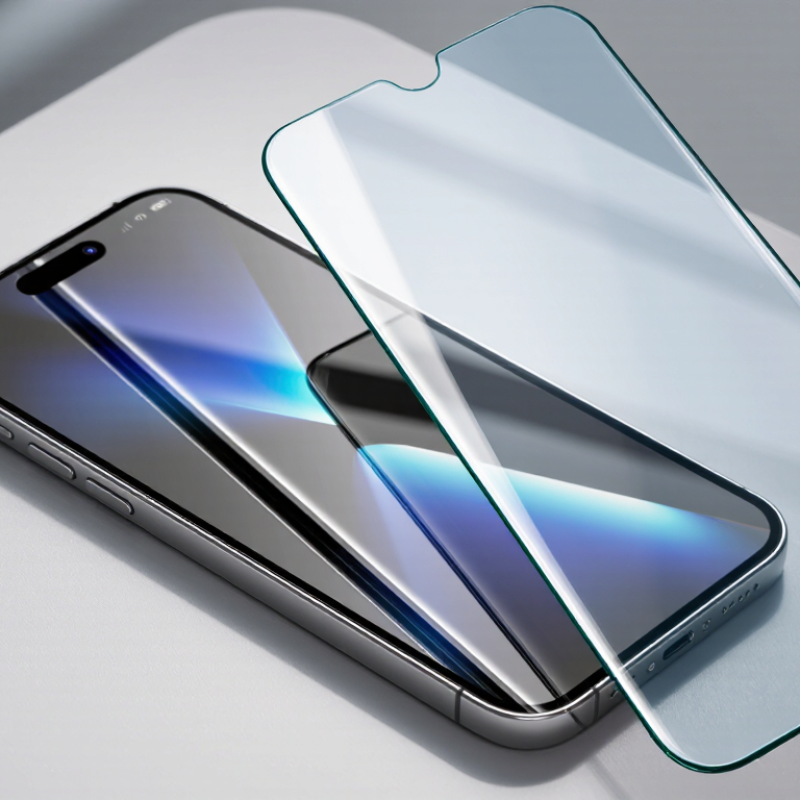
Understanding Ceramic Tempered Glass and Its Key Properties
Ceramic tempered glass is not always made to one exact recipe. The name may describe glass-ceramic material or strengthened glass with a ceramic-like surface. That distinction matters. Check the product’s material details instead of relying on the label alone.
Its key properties include hardness, flexibility, and resistance to scratches or impact. These qualities vary by construction and thickness. “Scratch-resistant” does not mean scratch-proof, and tempered glass can still crack after a sharp drop. Corners and edges are especially vulnerable. A hard floor is unforgiving.
Clarity and touch response matter, too. A protector may look clear in a shop but show haze under bright sunlight. Coatings can help reduce fingerprints, though they wear with use. Check that the edges fit your device and that touch remains responsive across the screen. It is easy to overvalue one advertised hardness number. Real-world durability is harder to predict, so treat specifications as guidance, not a guarantee.
| Property or Check | Typical Data or Behavior | Why It Matters | What to Look For |
|---|---|---|---|
| Material identity | “Ceramic tempered glass” is not a single standardized material name. It may refer to chemically strengthened glass, glass-ceramic, or a layered product. | These materials have different compositions and performance. The product name alone does not establish that the sheet is a glass-ceramic. | Request the material type and a technical data sheet. Check whether “ceramic” describes the glass itself or a coating or marketing category. |
| Scratch resistance | Hardness varies with composition, surface treatment, and test method. Mohs hardness is a qualitative scratch scale and does not predict resistance to every real-world scratch. | Fine particles such as quartz can scratch many glass surfaces; hardness claims should be interpreted in context. | Compare products using the same stated test method. Treat a hardness number without a method or test standard as incomplete information. |
| Bending strength | Strength depends on composition, thickness, edge quality, surface flaws, and strengthening process. There is no single universal strength value for all ceramic glass products. | Strength affects resistance to bending and crack initiation, but does not by itself predict impact or drop performance. | Compare values measured using the same test method and specimen dimensions. Look for test results rather than an unqualified “stronger” claim. |
| Strengthening process | Some cover glasses are chemically strengthened by ion exchange; some glass-ceramics may also be strengthened if their composition and process allow it. Not every ceramic glass product is tempered. | Strengthening can create surface compression, which helps resist crack initiation. The effect depends on the material and processing conditions. | Confirm whether the product is thermally tempered, chemically strengthened, or neither. Ask for process and performance details. |
| Thermal expansion | Some lithium-aluminosilicate glass-ceramics are designed for very low thermal expansion; values vary substantially by composition and can be near zero. Other formulations have higher expansion. | Thermal expansion affects dimensional stability and compatibility with frames, adhesives, and temperature changes. | Check the coefficient of thermal expansion and its temperature range in the technical data sheet when thermal cycling matters. |
| Optical clarity and color | Transparency, haze, and color depend on composition, thickness, surface finish, coatings, and any layers in the product. | Optical quality is important for screens, display windows, and viewing panels. A material label alone does not guarantee clarity. | Look for measured transmittance and haze at the intended thickness, plus a sample viewed under realistic lighting. |
| Impact and fracture behavior | Impact performance depends on thickness, support, edge design, flaw population, and test conditions. Glass-based materials can still crack or chip. | A high hardness or bending-strength value does not guarantee resistance to drops or edge impacts. | Use impact or drop-test results that match the intended product geometry and mounting conditions. |
| Thickness and fit | Available thicknesses depend on the product and manufacturing process. Small changes in thickness can affect stiffness, weight, fit, and optical behavior. | A material with suitable properties may still fail to fit or perform properly if dimensions and edges are unsuitable. | Verify thickness tolerance, flatness, edge finish, and compatibility with the frame or device before purchase. |
| Coatings and surface treatment | Anti-reflective, anti-fingerprint, or other coatings may be applied. Coating durability and performance vary by product and test method. | Surface treatments can improve usability but may wear or affect reflectance and cleaning behavior. | Check which coatings are present and request abrasion or durability test information if long-term performance is important. |
| Best choice by application | For display covers, optical performance and fit may be priorities. For cookware or thermal components, thermal expansion and heat resistance may matter more. | The “best” material depends on its intended use, operating conditions, and failure risks. | Rank requirements first, then compare verified data for the same application and test conditions. |
Note: Values and performance vary by composition, processing, dimensions, and test method. Use the product’s technical data sheet and application-specific test results for a reliable comparison.