

Choosing a Kids Stool from a Chinese manufacturer involves more than comparing prices and product photos. Buyers need to assess stability, edge finishing, surface coatings, material consistency, and age-appropriate dimensions. A stool that looks sturdy online may feel different when a child climbs onto it. Small details matter: the width of the feet, the grip beneath them, and whether corners feel smooth to the touch.
Design researcher Don Norman offers a useful principle: “Good design is actually a lot harder to notice than poor design.” For children’s furniture, that idea has practical weight. A well-designed stool should feel predictable in everyday use, not merely attractive in a catalogue. Buyers should request samples, inspect assembly points, and ask suppliers for clear product specifications and quality-control details. Requirements can vary by destination market, so confirm applicable testing and documentation with qualified professionals before placing an order.
This guide introduces ten Chinese manufacturers for global buyers, with attention to product range, customization, production capacity, and communication. It is meant to support due diligence, not replace it. No shortlist is perfect. Some suppliers may excel at molded plastic, while others offer stronger wood or metal options; public information can also be incomplete or outdated. Compare like with like, ask specific questions, and verify important claims directly. A careful review can help buyers find a Kids Stool supplier whose products suit their users, budget, and sourcing needs.
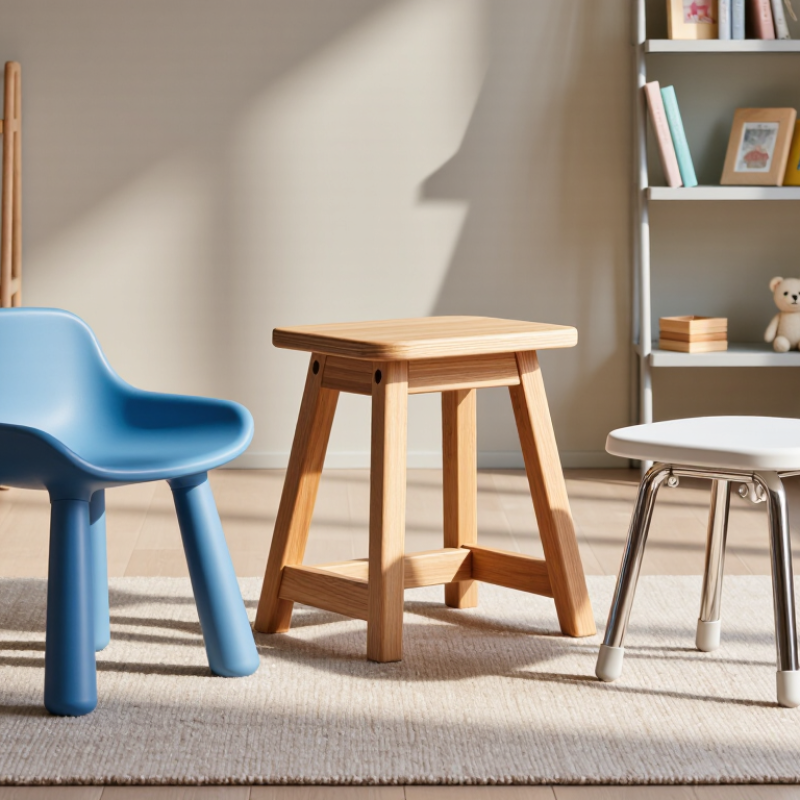
A children’s stool is a low seat or step platform sized for a child’s reach and posture. Common buyer age bands are toddlers, preschoolers, and school-age children, but age alone is a weak sizing guide. ASTM F2613 covers children’s chairs and stools intended for ages 5–12; younger children need closer supervision and age-appropriate designs. Fit matters more. Check seat height, platform depth, weight rating, foot grip, and stability on the actual floor.
Uses shape the product. A compact seat suits dressing or play, while a broad step stool helps children reach a sink or counter. Some designs fold, adjust in height, or include storage. Materials include solid wood, plywood, molded plastic, and metal frames; each brings trade-offs in weight, cleanability, durability, and grip. Rounded edges and a stable base matter when a child climbs. Not a guarantee.
The category also has commercial scale: Grand View Research valued the global kids’ furniture market at about USD 32.7 billion in 2023 and projected growth through 2030. That figure covers more than stools, so it signals market context, not stool demand alone. Buyers comparing manufacturers should request material specifications, load testing details, finish information, and age guidance. A small mismatch can matter: a stool that feels sturdy on carpet may slide on tile.

The bars show the midpoint of approximate seat-height ranges: 20–25 cm for toddlers (1–2 years), 25–30 cm for preschoolers (3–5 years), and 30–35 cm for early school-age children (6–8 years). These are practical sizing references, not regulated age-to-height standards. Choose a stool that lets the child sit with feet supported and use the intended table comfortably. Common options include wooden, plastic, and upholstered stools, in step, backless, and adjustable designs.
For global buyers comparing children’s stool suppliers, request complete test reports, not just a “passed” label. ASTM F2613 covers safety and performance requirements for children’s chairs and stools, including structural integrity and stability. EN 17191:2021 sets safety requirements and test methods for children’s seating. ISO 7173 describes strength and durability tests for chairs and stools. The standards serve different purposes. A report should name the exact model, materials, test conditions, and standard edition.
Check that samples match production stools. A lightweight stool may rock on a smooth floor, while a rough edge can catch a child’s sleeve. Ask laboratories to document stability, strength, durability, and accessible hazards, where applicable. Test loads and acceptance criteria can differ between standards, so passing one test does not automatically prove compliance with another. Small details matter.
The U.S. CPSC’s 2022 NEISS report estimated about 12.7 million emergency-department-treated injuries associated with consumer products. That figure is not stool-specific, but it underscores the value of product-level checks. Buyers should also review corrective actions and production quality records, then confirm that any design changes trigger reassessment. Paperwork can look reassuring. It can still miss a loose fastener or a changed plastic blend, so periodic sample testing is worth considering.
For global buyers, seat height should be matched to a child’s body, not just age. EN 1729-1:2015 sizes educational furniture by user stature, a more useful starting point than “toddler” or “junior” labels. Check the actual seat height in millimetres. A child should sit with feet supported and knees comfortably bent; dangling feet are a warning sign. Small details matter.
Weight capacity needs equally careful reading. Ask whether the stated limit is a recommended user load or a result from a defined test. ASTM F2613-22 covers safety requirements for children’s chairs and stools, including structural integrity and stability, but a standard’s scope is not a universal kilogram rating. Request the test method, applied load, sample details, and report date. A large number on a product sheet proves little by itself.
Durability depends on more than thick plastic or a sturdy-looking frame. ISO 7173:2023 describes strength and durability testing for chairs and stools, giving buyers a way to compare evidence across suppliers. Ask for results covering joints, legs, seat deformation, and repeated loading. Inspect edges and feet, too; rough seams or slipping pads show up in everyday use. A polished catalogue can hide weak spots. And test reports may not reflect years of real use. That gap deserves attention.
Specification note: Company names are omitted. The entries below are illustrative sourcing benchmarks for common kids’ stool designs, not verified specifications or test results from particular manufacturers. Confirm dimensions, load ratings, materials, and test methods with each supplier before purchasing.
| Reference Profile | Typical Construction | Seat Height | Suggested Load-Capacity Target | Suggested Durability Check | Buyer Verification Point |
|---|---|---|---|---|---|
| 01 — Low toddler stool | Molded polypropylene (PP) | 200–250 mm | 50 kg static load | Static-load test; inspect for cracking, tipping, and sharp edges | Resin grade, base footprint, and applicable test standard |
| 02 — Compact bathroom stool | PP with textured top and non-slip feet | 200–260 mm | 60 kg static load | Wet-surface stability check; repeated loading and foot-retention inspection | Slip-resistance method and performance on wet flooring |
| 03 — Lightweight carry stool | Hollow molded PP | 250–300 mm | 60 kg static load | Repeated load and carry-handle inspection; check for deformation | Wall thickness, handle strength, and declared product weight |
| 04 — Reinforced plastic stool | Reinforced PP with ribbed underside | 250–320 mm | 75 kg static load | Static-load test plus repeated loading; inspect ribs and joints | Reinforcement design, material specification, and test report |
| 05 — Wooden step stool | Solid wood or plywood construction | 250–350 mm | 50 kg static load | Joint and fastener inspection; check finish, wobble, and edge smoothness | Wood species, panel thickness, coating, and moisture condition |
| 06 — Foldable stool | PP platform with folding metal or polymer supports | 220–300 mm | 50 kg static load | Repeated open-close cycling; check locks, hinges, and pinch points | Locking mechanism, cycle-test result, and finger-trap safeguards |
| 07 — Adjustable-height stool | Plastic seat with adjustable support structure | 300–450 mm adjustable range | 60 kg static load | Adjustment-cycle and stability checks at every height setting | Adjustment lock, minimum/maximum height, and stability test method |
| 08 — Padded-seat stool | Wood or metal frame with foam and upholstery | 300–400 mm | 50 kg static load | Frame-load check; inspect seams, staples, foam recovery, and wobble | Upholstery composition, cleanability, and frame-joint construction |
| 09 — Metal-frame stool | Steel or aluminum frame with plastic or wooden seat | 300–450 mm | 75 kg static load | Frame and joint checks; inspect coating, welds, and exposed edges | Metal grade, corrosion protection, weld quality, and edge finishing |
| 10 — Large-seat multipurpose stool | Wide molded PP or reinforced composite seat | 300–450 mm | 75 kg static load | Static-load and stability checks; inspect for permanent deformation | Usable seat dimensions, base stability, and documented load rating |
Load figures and durability checks are suggested procurement targets only. They are not substitutes for age-appropriate safety assessment, applicable regulatory testing, or supplier-issued test documentation.
China’s kids stool suppliers commonly offer solid-wood, plywood, plastic, and metal-frame designs. Options range from low step stools to adjustable seating, with rounded edges, grip surfaces, and compact packaging. Fortune Business Insights estimated the global furniture market at US$736.6 billion in 2023, but this broad figure does not measure children’s stools specifically. Buyers should treat it as market context, not a stool-demand forecast.
OEM services may include custom dimensions, colors, logos, packaging, and product drawings. Ask suppliers for material specifications, load-test records, finish details, and sample lead times. Export experience varies by factory; request recent destination-market references and clear shipping terms. A polished catalog is not proof of consistent production. Even small details, like a slippery foot pad, can matter in daily use.
Tips: Compare samples on a hard floor, check for wobble, and confirm the stated weight capacity. Request inspection criteria before mass production. One weakness: custom changes can extend lead times, so approve drawings and packaging early.
When comparing kids stool manufacturers in China, global buyers should verify records before discussing price. Ask each supplier for current compliance documents relevant to the destination market and exact stool model. Check report dates, product photos, materials, and factory details; a generic certificate may not cover the item offered. Request samples with the same plastic, wood, or finish planned for production. Details matter. Then confirm MOQ by color and design, not just by shipment. Some factories quote a low MOQ but apply it only to one standard color. That’s an easy detail to miss.
Lead time should be split into sample approval, material purchasing, production, inspection, and packing. Ask for a dated schedule and clarify what happens if a component arrives late. For quality data, review inspection criteria, defect categories, and recent batch records rather than accepting “passed” as the whole story. Useful checks include stool height, wobble on a flat floor, edge finish, load-test method, and carton condition. Test numbers may look tidy, but sampling plans and test conditions matter. Compare identical models and keep approved samples for reference. One imperfect point: schedules can still slip, even with careful checks. Build a small buffer into launch plans and document agreed tolerances in writing.
INFORMATION CENTER
RESOURCES & MORE
INSPIRATION FOR YOU
© Copyright 1981 - 2025 | California Patio™ All Rights Reserved

