

Choosing the right Carry On Suitcase size and weight can make airport travel noticeably easier. A case that fits the overhead bin saves time, reduces stress, and keeps essential items within reach. However, there is no single worldwide standard for cabin baggage. Airlines often set different limits for dimensions, weight, and personal items.
A practical starting point is to check your airline’s current baggage policy before packing. Many carriers accept cabin cases close to 22 x 14 x 9 inches, but measurements may include wheels, handles, and outer pockets. Some airlines also use centimetres, which can create small but important differences. Measure your packed suitcase, not just the empty shell.
Weight matters too. A lightweight case leaves more room for clothing, electronics, and toiletries. Yet a lighter frame may feel less durable after repeated trips. That trade-off deserves attention. I have found that four smooth wheels, a firm telescoping handle, and strong corner protection often matter more than extra compartments. Still, personal travel habits change the best choice.
Pack a test load.
Place the suitcase on a home scale. Then lift it briefly, because airport handling can feel different from reading a number. Keep heavier items near the wheels, and avoid overfilling the zipper area. Fabric expansion may help, but it can also make the case exceed the permitted depth. Before leaving home, compare the final size and weight with the airline’s official guidance. Policies change, and relying on an old travel memory can be an expensive mistake.
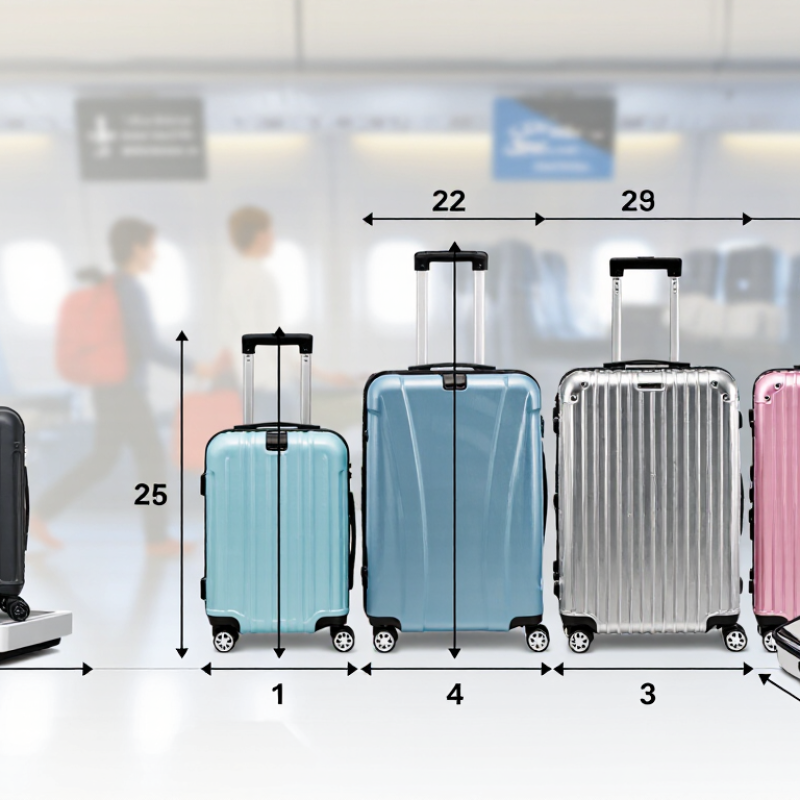
A carry-on suitcase is luggage stored in the aircraft cabin, not in the checked baggage hold. Its size means the suitcase’s complete outside measurements. Include wheels, handles, side pockets, and other fixed parts. The International Air Transport Association recommends a cabin-bag reference size of 56 × 45 × 25 centimetres. This guidance is not a universal rule. Each airline may set smaller dimensions or a different weight limit.
Weight means the suitcase and everything packed inside it. Common limits range from 7 to 10 kilograms, although some airlines allow more or less. A suitcase can meet the size standard and still fail the weight check. That detail surprises many travellers.
A compact case filled with shoes, electronics, and thick clothing becomes heavy quickly. Soft sides can also expand beyond the stated depth.
Measurement errors are common. A traveller may measure only the shell and forget the wheels. That mistake can matter at the gate. SITA’s 2024 Baggage IT Insights reported 6.9 mishandled bags per 1,000 passengers in 2023, showing why accurate baggage handling remains important.
The report concerns checked and transferred luggage, not only cabin cases, but careful identification still reduces confusion. Check the operating airline’s current baggage table before departure, because aircraft space, fare type, and route can change the allowance. Rules are less simple than suitcase labels suggest.

What Is a Carry On Suitcase Size and Weight?
Standard carry-on dimensions differ across major airlines, so one suitcase may not fit every aircraft. A widely accepted limit is about 22 x 14 x 9 inches, or 56 x 36 x 23 centimeters. However, some airlines allow a narrower case, such as 55 x 40 x 20 centimeters. Others provide slightly more depth. Always check the current allowance for your route and ticket type.
Measurements usually include wheels, handles, and outside pockets. That detail matters. A case that looks compact may exceed the limit when fully packed. Carry-on weight commonly ranges from 7 to 10 kilograms, although some airlines use different limits or no published weight limit. The cabin crew may still require safe handling. A heavy suitcase can become awkward in a crowded aisle.
Tips: Measure your packed suitcase on a flat floor. Include every outer part. Use a small luggage scale before leaving home. Keep heavier items near the wheels for better balance. Also, confirm whether a personal item has separate size rules. The mistake is easy. I once focused only on height and ignored the wheels. That small oversight could mean checking the bag at the gate. Dimensions also vary by aircraft, so the official airline page remains the most reliable source before departure.
Standard carry-on limits commonly used across major airline policies
The chart compares commonly published maximum cabin-bag limits. Dimensions are shown in centimeters and represent length, width, and height; weight is shown in kilograms. A practical internationally compatible choice is a suitcase no larger than 55 × 35 × 20 cm and no heavier than 7 kg, although exact restrictions vary by fare type, route, and airline.
A carry-on suitcase must satisfy two separate rules: size and weight. Many airlines allow around 55 x 40 x 20 centimetres, but limits differ by route and ticket type. Some permits are smaller. Check the airline’s current baggage page before packing. Measurements usually include wheels, handles, and outside pockets. A case may fit at home but fail inside the airport sizing frame.
Weight limits often range from 7 to 10 kilograms. The airline measures the complete bag, not just its contents. That includes the suitcase itself, laptop, jacket, and small items stored in outer compartments. Staff may use a calibrated scale at check-in or the gate. Enforcement can vary, which makes assumptions risky. A suitcase label is not proof of compliance.
Tips: Weigh the packed case on a household scale. Lift it once, then confirm the reading on a flat surface. Leave about 0.5 kilograms of spare capacity. Pack heavy shoes near the wheels for better balance. Keep documents and medication accessible. A personal item may have a separate size limit, so measure it too. Recheck the rules close to departure; they can change, and memory is not a reliable measuring tool.
Carry-on rules vary, so measuring your suitcase matters more than trusting its label. IATA cabin-baggage guidance commonly references a maximum size near 56 × 45 × 25 cm, including wheels and handles. However, each airline may publish different limits and weight allowances. Many economy fares allow about 7 kg, but this is not universal. SITA’s 2024 Baggage IT Insights reported 6.9 mishandled bags per 1,000 passengers in 2023, showing why accurate baggage handling information remains important.
Measure the case while it is fully packed. Place it upright on a hard floor. Use a tape measure from the lowest wheel point to the highest handle point. Measure width at the widest side, including pockets and side grips. Measure depth from the front surface to the furthest rear point. Do not compress soft sections to create a smaller figure. The suitcase may look compliant until a bulging pocket adds several centimetres.
Weigh it on a calibrated household scale after packing. Lift the suitcase, then subtract your body weight from the combined reading. I use this method, though my scale sometimes changes by 0.2 kg. That small difference deserves attention near the limit. Measure again after adding a laptop, shoes, or travel documents. Record the final dimensions and weight beside the airline’s current baggage page, not an old booking email. Regulations change, and suitcase tags can be surprisingly optimistic.
Packing within carry-on limits starts with the airline’s own rules, not a universal standard. IATA commonly references cabin baggage near 56 × 45 × 25 centimetres, including wheels and handles. However, airlines may set smaller dimensions or weight limits, often between 7 and 10 kilograms. Check the current policy before packing. Rules can change by route, fare, and aircraft.
Measure the suitcase when it is full. Bulging fabric can add several centimetres. Use a small luggage scale, then leave about 0.5 kilograms unused. That margin protects you from scale differences at the airport. Pack shoes at the base and place socks inside them. Wear your heaviest jacket instead of compressing it into the case. Liquids should follow the airport’s screening limits, usually containers of 100 millilitres or less in one transparent bag.
SITA’s 2024 Baggage IT Insights reported 6.9 mishandled bags per 1,000 passengers in 2023. That figure covers checked baggage, not cabin cases, but it reinforces the value of keeping essentials close. Place medication, documents, electronics, and one change of clothes in your personal item. I still overpack chargers sometimes. A simple test helps: remove three items, then ask whether each one earns its space. If the suitcase barely closes at home, it will probably fail at the gate.
INFORMATION CENTER
RESOURCES & MORE
INSPIRATION FOR YOU
© Copyright 1981 - 2025 | California Patio™ All Rights Reserved

